W-8 IRS Forms Made Simple
IRS Forms W-8 are essential for documenting foreign tax status and managing U.S. withholding and reporting obligations. With multiple form types, complex validation requirements, and expiration rules, understanding how to collect and manage W-8 forms correctly is key to maintaining tax compliance.
No Industry Standard Template
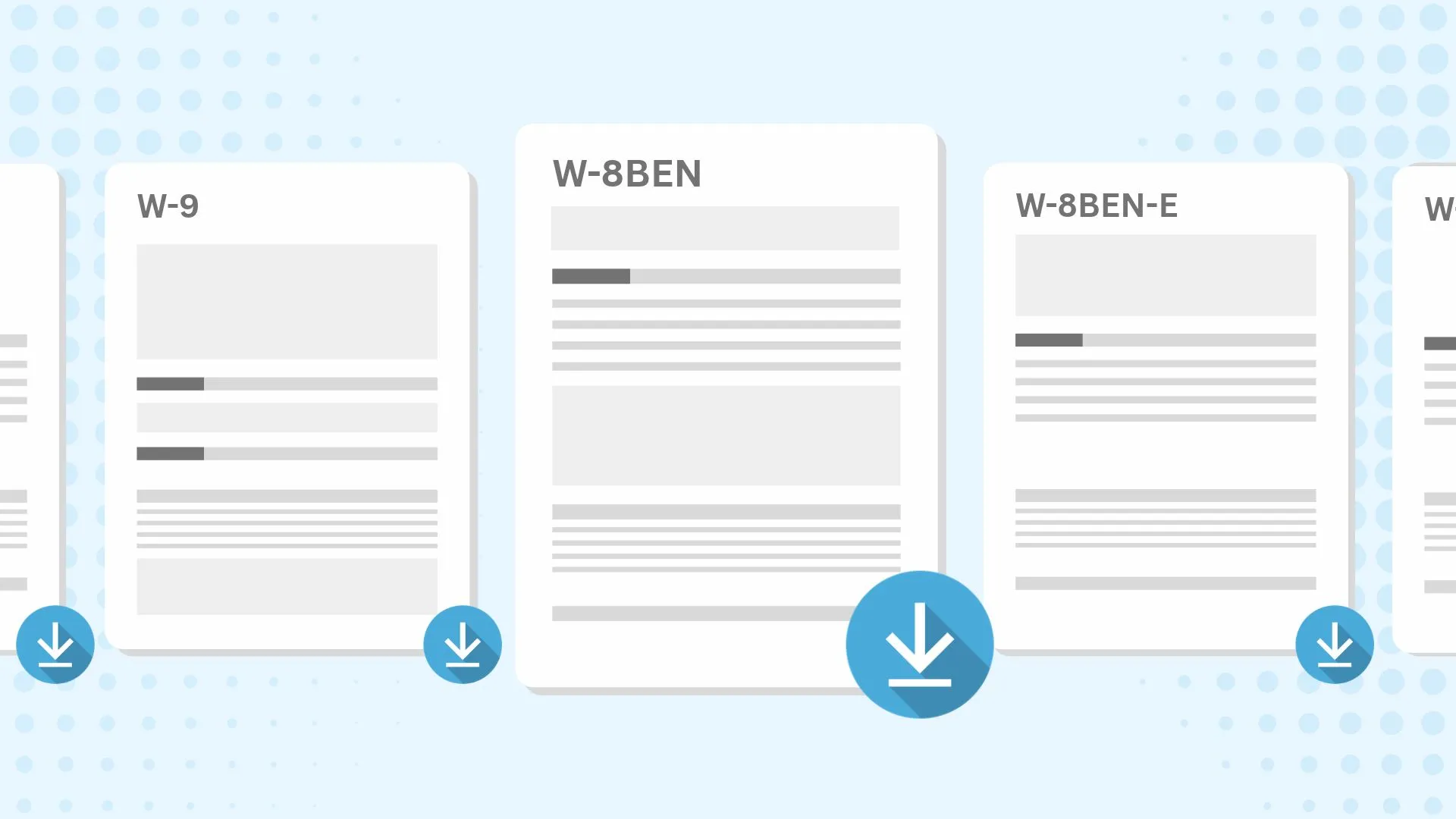
When it comes to IRS forms, the W-8 series stands out for its complexity compared to the familiar W-9. Unlike the single-page W-9, the W-8 series includes multiple forms, each designed for a specific type of account holder or tax situation. This variety ensures that different entities—whether individuals, organizations, or intermediaries—provide the correct tax information. For example, Form W-8BEN is used by foreign individuals, while W-8BEN-E applies to entities.
Tax-exempt organizations use Form W-8EXP, and Form W-8ECI is for effectively connected income. Intermediaries and flow-through entities rely on Form W-8IMY, which often includes supporting documentation like withholding statements. There’s even the sometimes-overlooked Form 8233 for service exemptions. Each form serves a precise purpose, reflecting the diverse scenarios that can arise for non-U.S. persons and entities receiving U.S. income.
Because these forms are more detailed than a half-page W-9, organizations must not only determine when a W-8 is required but also ensure the form is properly completed and validated. This involves checking all supplied information, from basic account details to more complex elements like tax treaty claims, to confirm compliance with IRS regulations.
Follow us and never miss an update
Transcript
Unlike the single Form W-9, the W-8 series includes multiple forms, each used for a different type of account holder or tax situation. For example, you have the W-8BEN for foreign individuals, the W-8BEN-E for foreign entities, and the W-8EXP for foreign tax-exempt organizations. You have the W-8ECI for effectively connected income. You have the W-8IMY for intermediaries and flow-through entities, along with supporting documentation, which may include withholding statements. And not to mention the often-forgotten Form 8233, for exemption from withholding on compensation for personal services. That’s a lot of different Forms W-8, compared to the single-page Form W-9.
Organizations must not only determine that a W-8 is, in fact, required, but also validate the W-8 that is ultimately supplied by their customer. As we just discussed, there are many. Most Forms W-8 are several pages long, and they require far more information than the single-page Form W-9. That also means there are more validations to perform, ranging from a field-by-field checklist to reviewing things like tax treaty claims for validity.
W-8s have a built-in expiration cycle. A form expires at the end of the third calendar year after the year it was signed. So, for example, if you collect a W-8BEN-E or W-8BEN in July 2026, that form is due to expire on December 31, 2029.
You can see the complexities here from a validation perspective, a collection perspective, and a tracking and management perspective. So, what does that really mean for you in practice?
First and foremost, you need a tracking system. That’s ideally not Excel, by the way. You need a system that actively monitors for form expirations, because you want visibility into upcoming expirations well in advance, whether it’s a W-8 reaching its natural expiration or a form expiring due to a change in circumstances.
There are real consequences if a form expires and you don’t have an updated form on file. For example, say a customer was claiming a treaty and receiving a reduced rate of withholding, but that form expires. They are no longer entitled to that reduced rate. If they haven’t submitted a new form ahead of the expiration to continue the treaty claim, you’re required to withhold at the default rate of 30%. This assumes a non-U.S. person is being paid U.S.-source income and making a treaty claim.
This is a perfect example of how what happens at the front end directly impacts how you withhold and what you report.
What are IRS Forms W-8 used for?
IRS Forms W-8 are used by foreign individuals and entities to certify their foreign tax status for U.S. withholding and reporting purposes. Depending on the form and circumstances, they may also be used to claim reduced withholding rates or exemptions under applicable tax treaties.
What are the different types of IRS Forms W-8?
The main IRS Forms W-8 include W-8BEN for foreign individuals, W-8BEN-E for foreign entities, W-8ECI for income effectively connected with a U.S. trade or business, W-8EXP for certain foreign organizations claiming exemptions, and W-8IMY for intermediaries and certain flow-through entities. Each form serves a different tax documentation purpose.
How long are IRS Forms W-8 valid?
Most IRS Forms W-8 are generally valid until December 31 of the third calendar year following the year they are signed, unless a change in circumstances makes the information incorrect. For example, a Form W-8BEN signed in 2026 would generally expire on December 31, 2029. Certain forms and certifications may have different validity rules.
What happens when an IRS Form W-8 expires?
When a Form W-8 expires, the withholding agent generally cannot continue relying on it to establish the payee's foreign status or treaty benefits. If valid replacement documentation is not obtained, the withholding agent must apply the relevant IRS presumption and withholding rules, which may result in a 30% withholding rate on certain U.S.-source payments.
What is the difference between Form W-8BEN and Form W-8BEN-E?
Form W-8BEN is generally completed by foreign individuals, while Form W-8BEN-E is used by foreign entities. Both forms establish foreign tax status and may support claims for reduced withholding under applicable tax treaties. Form W-8BEN-E also includes additional requirements relating to entity classification and FATCA status.
Share with your community
Validating Tax Forms | U.S. TIN, GIIN and FTIN
Learn why validating TINs, GIINs and FTINs is essential for tax compliance. Discover how proper validation prevents backup withholding.
Watch Now